




|
Lancaster First United Methodist Church
April 4, 2010
Isaiah 55:6-13 & John 20:1-18
Rev. Robert McDowell
“The Story of Three Gardens”
One of the reoccurring themes we find throughout the bible is a focus on
gardens. And since the bible is a collection of sixty-six books that has
been written over the course of several centuries, and by many different
authors, any reoccurring theme is worth some serious thought and focus.
The bible, in telling us the story of God’s plan of salvation for the world,
refers to three gardens, one of which is mentioned in our Gospel reading
this morning, but we’ll get to that soon enough.
From the opening of his Gospel, John has already been pointing us way back
to the first garden in the bible, the Garden of Eden. You might remember
that John begins his gospel with three very important words, “In the
beginning.”
These are the same three words that begin the bible. And from there, these
three words lead into the creation story. In the story of creation, we read
about the beautiful Garden of Eden, a garden that God planted which included
trees, rivers, and fruit to eat.
Next, God creates man to take care of the garden and to freely eat the fruit
from the garden with the exception of the fruit from one particular tree,
the tree of the knowledge of good and evil. The garden was given the name
“Eden” because the word, “Eden,” literally means, “delight.” So this was a
very beautiful, fruit-bearing, and delightful place. The creation story also
tells us that God created a woman from the man and together they provided
companionship for each other and they took care of God’s creation.
The picture here, from the very beginning of the bible is that God created
the world and called it good. It was a world that was filled with beauty,
delight, abundance, peace, and harmony. This description of God’s creation
of the world and the Garden of Eden tells us a lot about who God is.
First of all, God is the creator, meaning that God is set apart from
creation and yet maintains a close relationship with creation.
Secondly, God’s desire is for creation to be filled with beauty and harmony.
This was the original intention of God’s creation.
And thirdly, God entrusts us with caring for creation.
Not too long after creation, the Book of Genesis tells us that we disobeyed
God by eating the fruit of the tree of good and evil and because of this
disobedience, the ground was cursed and for the first time, we hear about
thorns and thistles growing in God’s beautiful garden.
The story of this first garden is a story that reminds us that even though
we can see glimpses of God’s beauty and presence in creation, it is also a
world that is filled with sin and brokenness. We don’t have to look too far,
to see the thorns and thistles that are still part of God’s good creation.
High unemployment, poverty, war, disease, hopelessness, pollution, violence,
and unfortunately, we can easily add more to this list.
Throughout the Old Testament, the people of Israel knew about this first
garden and God’s original design for creation. They knew that even though
God had chosen them to be a people who would care for creation, that in some
ways, they were also part of the problem because of their sin and
disobedience. But they also maintained hope that one day God would make
everything thing new again.
Listen to the prophet Isaiah who points the people of Israel to the future
hope when those thorns and thistles will be totally removed. Isaiah says,
“For you shall go out in joy, and be led back in peace; the mountains and
the hills before you shall burst into song, and all the trees of the field
shall clap their hands. Instead of the thorn shall come up the cypress;
instead of the brier shall come up the myrtle; and it shall be to the Lord
for a memorial for an everlasting sign that shall not be cut off.”
So when the gospel writer, John, begins to tell us about Jesus, he has us
think back to this first garden. The first garden which represents how God
created the world and called it good. The first garden, which soon after God
created it, became filled with thorns and thistles because of humanity’s
sin. The first garden, which was awaiting to be redeemed and renewed by a
special act of God’s grace when the thorns and thistles of this world would
finally be uprooted.
Once we know about this 1st garden, John is then able to tell us about a 2nd
garden which is the location of the Easter story found in our Gospel reading
this morning. And this 2nd garden is known as the Garden Tomb. Mary
Magdalene comes to visit the tomb of Jesus. The tomb is in a garden.
If you go to the Holy Land today, you can visit what is called “The Garden
Tomb” just outside of Jerusalem which is one of two places that Christians
believe Jesus’ was laid to rest after his crucifixion. It’s a beautiful
place with many flowers and you can even go into the tomb. And even though
this might not be the actual garden tomb of Jesus, scholars are in general
agreement that it at least has the look and feel of what the garden tomb of
Jesus would have been like.
When Mary notices that the tomb is empty, she immediately goes to tell Peter
and another disciple. After they both come to the tomb and find that it is
empty, they return to their homes but Mary stays in the garden.
With tears in her face and still not knowing who might have taken Jesus’
body, she enters the tomb and she sees two angels who ask her why she is
weeping. Mary then turns around and she sees Jesus, only she doesn’t
recognize him right away since he was now in his resurrected body.
Like the angels, Jesus asks Mary why she is weeping. And notice what the
gospel writer, John, says next. This is a very interesting detail.
“Supposing him to be the gardener.”
Mary thought that Jesus was a gardener because after all this was a garden
tomb. In a way, Mary was right. Jesus is a gardener, because it would be by
his death and resurrection that the thorns and the thistles of God’s good
creation would finally be removed forever.
This is the good news of Easter. Jesus, the gardener, is the Lord and Savior
of the world. Jesus, the gardener, is the one to whom the prophet Isaiah was
pointing. Jesus, the gardener, was God himself, who came so that we might
have new life. Jesus, the gardener is the new Adam because of his perfect
obedience and death on the cross. Jesus, the gardener, the one who reversed
the curse on creation thanks to the empty tomb. Jesus, the gardener, who
couldn’t be contained behind a large stone of a cold tomb. Jesus, the
gardener, the one who is more than able to help us overcome the thorns and
thistles of life. Jesus, the gardener, the King of Kings and the Lord of
Lords.
The good news of our faith is that through the resurrection of Jesus Christ,
the first garden , God’s good creation, has been redeemed and reclaimed by
God in the 2nd garden, the Garden Tomb. And here’s the really good news. You
and I are part of that first garden, for we were created in the image of
God. And because of Easter, we are invited to receive the saving and healing
love of Jesus Christ which can remove the thorns and thistles in our lives
so that we can live in a personal relationship with God.
An Anglican Church Bishop led a group of lay people in his diocese to the
Holy Land to visit the sites of Jesus. During their trip, they visited the
place which is believed to be where Jesus was crucified. And then they
visited the Garden Tomb. All during the trip, the Bishop carefully explained
the meaning of each of these sites.
There was an older man on the trip who wasn’t a member of the parish and who
only attended church on rare occasions. He lived in the area that the parish
was located and joined the group for the trip because he had always wanted
to visit the Holy Land. The Bishop could tell that this man was deeply moved
as they retraced the footsteps of Jesus.
After they had visited the place where Jesus was crucified and the Garden
tomb, this man turned to the Bishop for some reassurance and asked him, “Are
you saying that Jesus really lived and that you believe he actually taught
and healed people as you said.” “That’s right,” the Bishop said. “Jesus was
a real person who lived, taught, and healed people during the first
century.”
The older man continued his questioning, “And he really died on a cross and
then came out of the tomb alive and he’s alive today?” Again, the Bishop
responded, “Yes, that’s right. Jesus really died on a cross and rose again,
and is alive today.”
That’s all this man needed to hear. He said, “I want to become one of his
followers, then.” So right there, during their trip to the Holy Land, this
older man accepted Jesus Christ, was baptized, and from that day on, became
a follower of Jesus.
It’s here at this second garden, the Garden Tomb, that John invites us to
join Mary in hearing Jesus call our name so that we can know that Jesus
truly is the one who has defeated sin and death and offers to us new life in
God’s new creation.
And this leads us to the biblical story of the third garden. The New
Jerusalem Garden. If the first garden is the story of God’s good creation
which has become broken through our disobedience, and if the second garden
is the garden of the empty tomb where Jesus defeated sin and death through
his death and resurrection, the third garden is that time in the future when
heaven and earth will come together and all of creation will be renewed
forever.
Notice that after Mary recognizes who Jesus is, she tries to embrace him,
but Jesus doesn’t allow her to do so, because he had not yet ascended to be
with his heavenly Father. Now, why would Jesus not allow Mary, who has just
discovered that Jesus is alive, to embrace him? I think if we keep in mind
that there are three gardens of which the bible speaks, Jesus’ response to
Mary in these verses might make a little more sense.
Jesus’ resurrection is the launching of God’s long awaited new creation.
It’s a launching of new life and hope but not the final victory itself.
There are still thistles and thorns in creation that need to be removed even
after the empty tomb. And Jesus expects us, you and me, to be his gardeners
and to sow seeds of hope in caring for all of God’s people and all of God’s
creation.
What does Jesus tell Mary right after he tells her to not cling to him? He
tells her to go and share the good news of his resurrection with the other
disciples. And this is why Mary is known as the Apostle to the Apostles.
Because she went and did just as Jesus had told her. And this is just a
brief side note but it’s worth mentioning. Jesus shows us that if you need
something done, ask a woman to do it.
By telling Mary to not cling to him, but to instead, begin sharing the good
news of the resurrection, Jesus is reminding us that there are more than two
gardens. There’s the Garden of Eden that God created and called good but
became infected with thorns and thistles through our sins and disobedience.
Then, there’s the Garden Tomb in which Jesus has inaugurated new creation
thanks to his death and resurrection. But all of this still points us to the
third garden in the bible. To find this garden, we go to the very end of the
bible, the Book of Revelation and in the last chapter, we get a glimpse of
that time in the future when Jesus will reappear and will set up his rule
over all of creation.
We are told that this third garden will have a tree of life with all kinds
of fruit and a river will run through it reminding us of the first garden
before the thorns and thistles. In this third garden, there will be no more
crying, no more mourning, no more tears, and no more death. From beginning
to end, the bible is a story of three gardens. The Garden of Eden, the
Garden Tomb, and the Garden of the New Jerusalem.
Like he did for Mary, Jesus calls each one of us, to leave this Garden Tomb,
and go into the world to share the good news of Jesus Christ by caring for
God’s good creation. We are called to be agents of God’s healing love in our
community and world. We are the ones Jesus is depending on to serve as his
gardeners for a broken and hurting world.
This was never clearer to me than during a late July afternoon this past
summer as I was standing on my second floor hotel balcony looking down on
the city streets of San Lucas Toliman in Guatemala. I was with a mission
team of fourteen people from my church who had gone there to work on a water
project which would provide clean water to a small community located just
outside of the city.
Our team was exhausted from a long day of digging trenches under the hot
Guatemalan sun. Someone on my team had awaken me from my pre-dinner nap and
said, “Robert, come to the balcony. You gotta see what Rock is doing!”
Rock was a member of my church who is also a funeral director. From our
second floor balcony, he was playing a game with about twenty Guatemalan
children who had gathered below. Since he couldn’t speak Spanish and they
couldn’t speak English, he had them playing a game in which they had to do
exactly what he was doing which were often silly motions and gestures with
his face and arms.
They loved it and were laughing the whole time. In just a few minutes, the
twenty children turned into thirty children and I said to Rock, “Now what
are you going to do?” He said, “I’m going to go down to the store and buy
candy to hand out to them.”
And sure enough, that’s what he did. The only problem was, as he was
distributing the candy, those thirty children turned into forty children. He
was their hero!
Then, Rock got another idea. He ended up forming a parade and had the
children follow him up and down the polluted streets of this impoverished
city as he whistled some silly song along the way. By the time the impromptu
parade ended, there must have been at least 50 to 60 children who had been
following him.
“Rock’s parade,” as we now refer to it, became one of the highlights of our
mission trip. By stepping out in faith, Rock wasn’t so much a funeral
director, as he was a gardener, who was living out his resurrection faith by
tilling the soil of God’s garden and offering the hope and good news of
Jesus Christ.
And until Jesus comes again, and we find ourselves in the third and final
garden of God’s new creation, may we all do the same.
Happy Easter!
Thoughts/Action Steps for the Week
1. Do you like gardening? Based on the sermon today, what aspects of
gardening can help you offer the love of Jesus Christ to our broken and
hurting world?
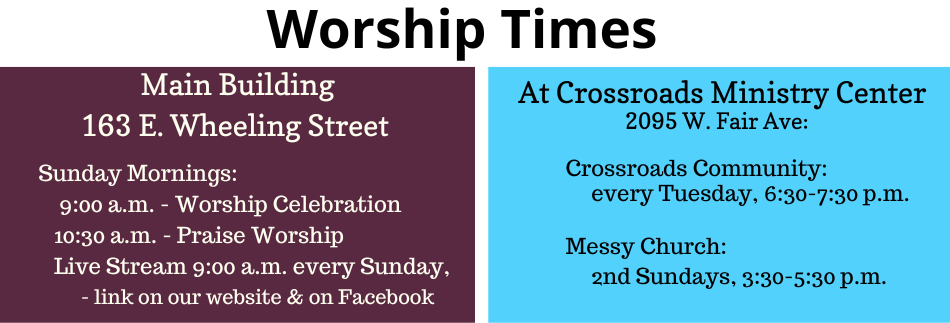
2. Is God calling you to participate in our new “Second Saturday” mission
outreach to our community? We will be meeting at our Crossroads facility,
2095 W. Fair Ave., this Saturday at 8:30 A.M. This is our church’s way of
offering the good news of Jesus Christ in practical and simple ways on a
monthly basis.
3. What are the “thorns and thistles” you are dealing with in your life?
Allow the good news of Christ’s resurrection to strengthen you each day! |